

The value of useless challenges: why play will help us remain human in the age of AI
At the Human Driven AI Summit in Pompeii, an event that brought together entrepreneurs, scientists, researchers and innovation leaders on the same stage to reflect on the relationship between humans and artificial intelligence, I chose to approach the topic from a different perspective to the one most commonly adopted when discussing technology. I didn’t start with AI, but with game.
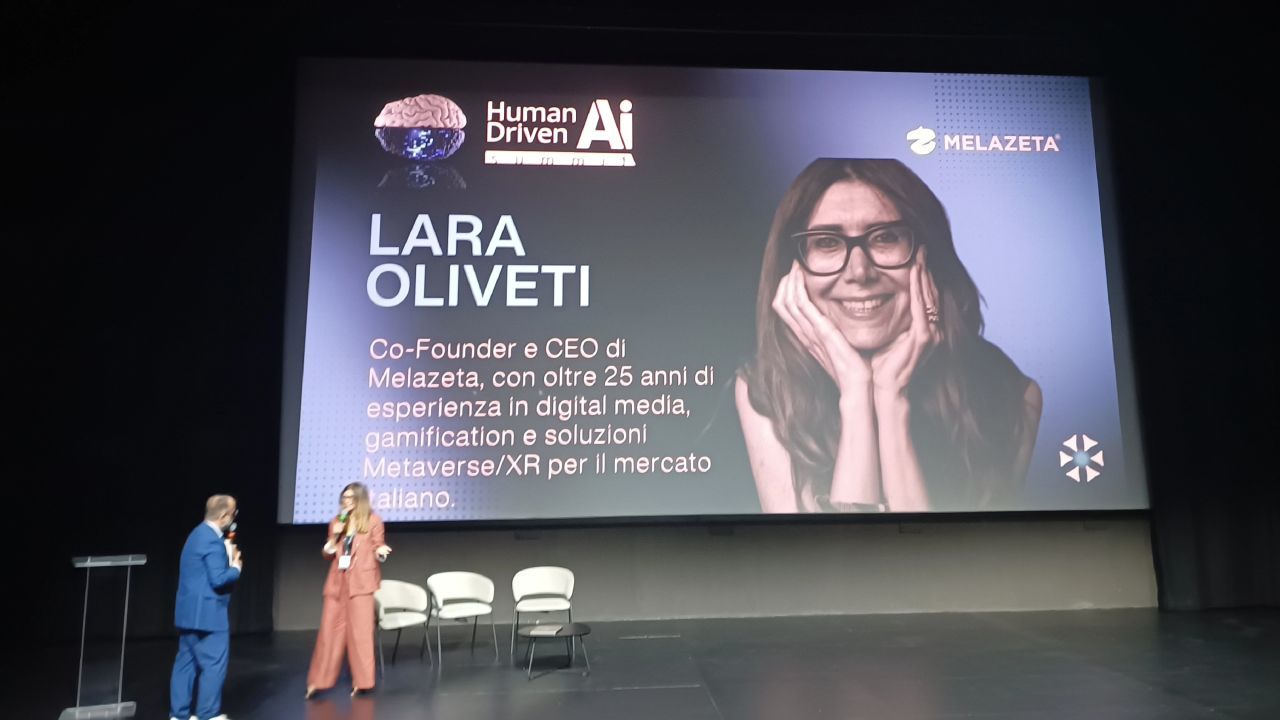
It may seem like an unusual connection. Yet I am convinced that it is precisely in play that some of the skills which will become most valuable in the coming years lie hidden. Whilst machines learn to generate content, analyse data, process images and produce increasingly sophisticated responses, human beings will be called upon to cultivate what machines lack: curiosity, imagination, critical thinking, the ability to experiment, to collaborate and to make sense of experiences.
Play has never been merely a form of entertainment. It is one of the main ways in which we learn, explore and understand reality. Children play to understand the world around them; scientists play with hypotheses before turning them into theories; innovators play with possibilities that do not yet exist. In this sense, play represents a genuine cognitive training ground, a safe space where we can imagine alternatives, test solutions and grapple with uncertainty.
For over twenty-five years, through Melazeta’s projects, we have been exploring the potential of play as a tool for learning and transformation. We have done so in companies, museums, schools and projects dedicated to cultural heritage. On each occasion, we have observed the same phenomenon: people learn more easily when they are engaged in a meaningful challenge, when they feel they have a goal to achieve, and when they can build knowledge through direct experience rather than simply receiving it passively.
This is where what I call the “value of useless challenges” comes into play. Useless on the surface, of course. Nobody really needs to climb a mountain, complete a mission in a video game or solve a particularly complex puzzle. And yet it is precisely these activities that generate one of the most powerful emotions we know: the pleasure of achievement.
The satisfaction we remember for the longest time rarely stems from achieving a result straight away. Instead, it arises from the journey that led us to it: from the effort, the attempts, the mistakes, the moments of uncertainty and the gradual realisation that we are improving. People grow when they tackle something they do not yet know how to do. The challenge is not an obstacle to learning: it is learning itself.
This principle underpins both game design and modern gamification methodologies. Models such as Yu-kai Chou’s Octalysis or Amy Jo Kim’s Game Thinking demonstrate how human motivation arises from a combination of elements such as autonomy, progression, a sense of competence, belonging and discovery. Game-based dynamics work because they tap into deeply human needs and transform the learning process into an engaging journey rather than a chore to be endured.
Another key lesson that games teach us is how to relate to mistakes. In traditional contexts, mistakes are often seen as something to be avoided. In games, by contrast, mistakes are an integral part of the process. We make a mistake, receive immediate feedback, adjust our strategy and try again. This is the mechanism underpinning serious games and, more generally, any effective learning experience. Mistakes do not represent a failure in learning; they are its driving force.
This insight becomes particularly interesting when applied to artificial intelligence. Personally, I regard AI as an extraordinary opportunity. I use it every day and am convinced that it can support people and organisations in a wide range of processes. However, like any technology, it brings with it a temptation: to eliminate the need for effort.
If all answers come instantly, we risk losing the pleasure of discovery. If every problem is solved automatically, we risk exercising our critical thinking skills less. If we systematically delegate the exploration of new possibilities to machines, we risk weakening the very skills that make us more human.
The data shows that gaming is already a significant part of our society today. According to the report Video Games in Italy in 2025 published by IIDEA, around 14.2 million Italians play regularly, equivalent to 29 per cent of the population, a percentage that is still lower than the average in many European countries. But the most interesting figure does not concern the gaming market. It concerns the skills that gaming continues to develop: problem-solving, collaboration, adaptability, resilience, decision-making and lifelong learning.
These are precisely the skills we will need in the organisations of the future, where we will work alongside AI agents, intelligent systems and collaborative robots. In an increasingly automated world, people’s value will not depend on their ability to compete with machines in terms of efficiency, but on their ability to do what machines cannot: give meaning, build relationships, imagine possibilities and deal with uncertainty.
Perhaps the real issue is not how intelligent machines will become. The most important question concerns how well we will be able to preserve our natural inclination towards discovery. Because the future will continue to belong to those who are willing to explore, experiment, make mistakes and start again. In a word, to those who continue to play.
- Human Driven AI Summit: https://humandriven-ai.com/it
- IIDEA, rapporto sul mercato videoludico italiano: https://iideassociation.com
Author: Lara Oliveti, CEO and co-founder of Melazeta, TEDx speaker.
If you’d like to find out more: : https://www.melazeta.com/servizi/games-gamification
Pubblicato il 29/09/2026

Let’s start a
conversation
Get in touch
Next level?
Contact us to unlock new possibilities with Games, Gamification, XR, and AI.